How to Reduce Risk Without Shutting Down Production
Modernization fear isn’t about cost — it’s about downtime risk.
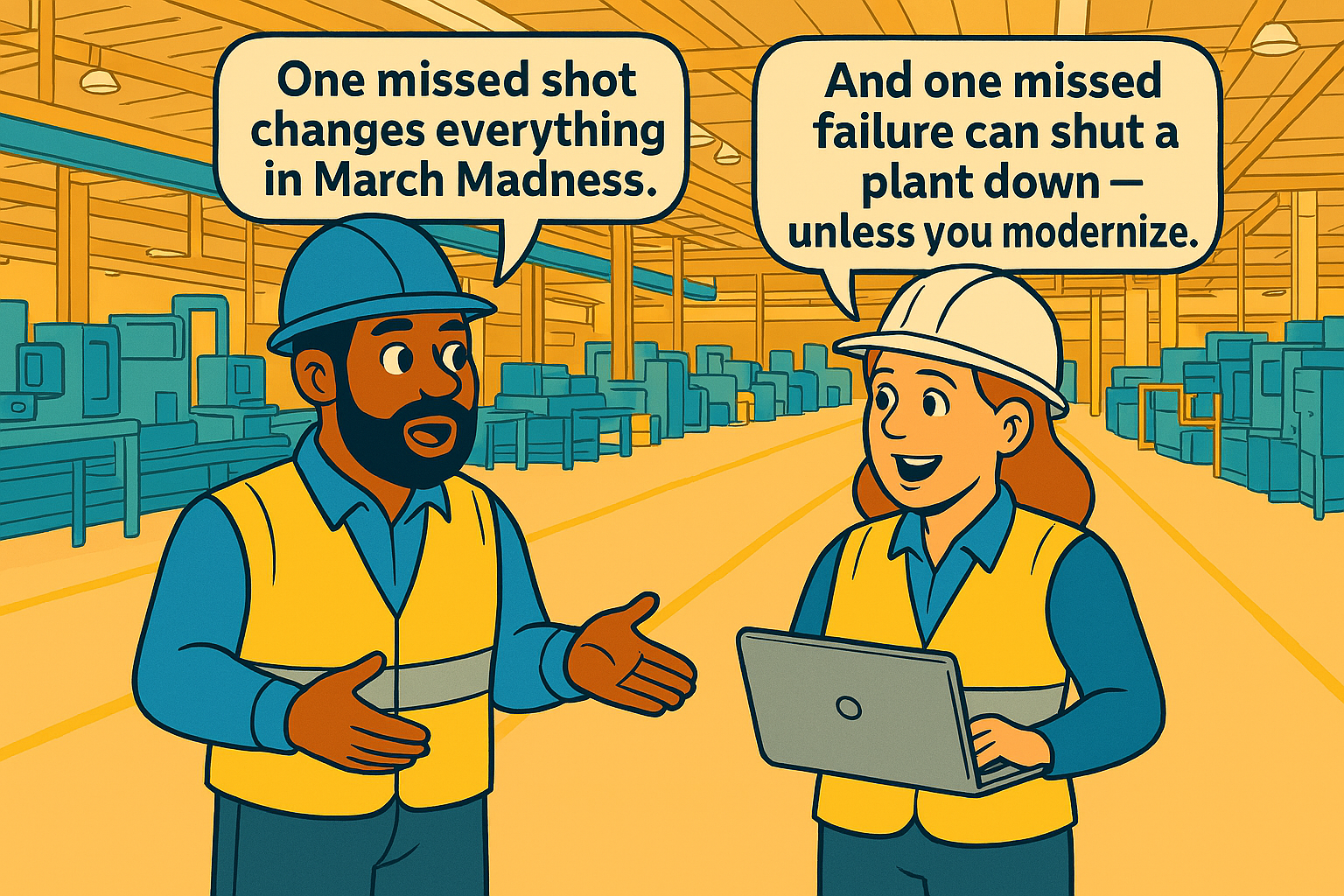
Most plants aren’t afraid of new technology. They’re afraid of what happens if production stops, even briefly. In a brownfield environment, systems are tightly coupled: one controller change can ripple into sequencing, interlocks, safety, quality, and shipping.
Modernization doesn’t require a shutdown — but it does require intent. The goal isn’t ‘new.’ The goal is reduced operational exposure: fewer surprises, faster recovery, better diagnostics, and a path that maintenance can support.
Why modernization fails when it’s treated as a “project”
When modernization is framed as a one‑time capital project, it inherits the wrong constraints: big‑bang cutovers, compressed commissioning, and a false assumption that documentation is accurate. Brownfield integrations are not plug‑and‑play. Planning must account for legacy compatibility, network realities, and commissioning discipline — especially when production is running.[1]
Replacement vs. risk‑reduction (they are not the same)
Replacement is a technology decision. Risk‑reduction is an operational decision.
Replacement asks: ‘What do we want to swap?’
Risk‑reduction asks: ‘Where do failures cascade? What is hard to support? What is becoming impossible to source? What causes the longest recovery?’
In practice, the safest modernization programs prioritize the highest‑impact points of failure first — and leave stable mechanical assets alone until there’s a reason to touch them.[2]
How offline prep + phased upgrades change the equation
Three moves consistently lower downtime risk: offline prep, phased upgrades, and standards‑based design.
- Offline prep: Stage panels, validate logic, and test configurations before you touch the live line.
- Phased upgrades: Reduce blast radius — one line, one cell, one panel, one network zone at a time.
- Standards: Predictability matters. Standards‑based maintenance and modernization practices improve reliability and reduce surprises.[3], [4]
Three concrete “no‑shutdown” modernization patterns
These are practical patterns teams use when they cannot afford a full shutdown. They are examples (not one-size-fits-all), meant to help you picture the approach.
Example 1 — PLC/HMI modernization with staged build + controlled cutover
When you need to migrate an aging controller platform, avoid ‘swap and pray.’ A safer pattern looks like this:
- Inventory & I/O map: Verify what is actually wired (not what drawings claim).
- Offline build: Assemble the replacement panel / controller configuration in a controlled environment.
- Point‑to‑point checkout: Validate each input/output and critical permissive before the cutover.
- Controlled cutover window: Move one cell/area at a time, with rollback steps documented.
- Post‑cutover monitoring: Trend alarms, scan times, and nuisance trips for a defined stabilization period.
What this prevents: long troubleshooting cycles driven by tribal knowledge and undocumented behavior.[5]
Example 2 — Network modernization by parallel path (segmentation without breaking production)
If the current control network is flat, unmanaged, or fragile, modernize the network in parallel:
- Build a new segmented network (zones/conduits) alongside the existing network.
- Move non‑critical assets first (historian taps, dashboards, engineering workstation access).
- Then migrate one production cell at a time during planned micro‑
- Keep addressing and naming conventions disciplined so maintenance can support it.
What this prevents: ‘one change takes down the plant’ scenarios caused by broadcast storms, unmanaged switches, or undocumented routing.[6]
Example 3 — Safety modernization as uptime protection (not just compliance)
Many plants treat safety as separate from uptime. In reality, poor safety architectures can create nuisance trips and long recovery time. A practical modernization approach:
- Start with the highest‑risk stations (manual intervention points, jam-clearing zones).
- Improve diagnostics so maintenance can identify the ‘why’
- Validate changes through a commissioning checklist (fail‑safe behavior, reset conditions, interlocks).
What this prevents: repeated nuisance stops, unclear reset logic, and extended troubleshooting after a safety event.[7], [8]
What experienced teams modernize first (and what they leave alone)
Start where failure impact is highest and supportability is lowest. A simple prioritization matrix:
Modernize first when the asset is:
- High impact on throughput or safety
- Hard to source (obsolescence, long lead times, discontinued support)
- Poorly instrumented (no diagnostics, long troubleshooting)
- A known single point of failure
Often leave alone initially when the asset is:
- Mechanically sound with stable performance
- Well understood and well documented
- Low consequence if it fails (easy bypass / low impact)
This is the difference between ‘replacement’ and ‘risk‑reduction.’ [9]
Checklist: modernization without downtime
Before you touch production:
- Verify what is actually installed (field walk + I/O verification)
- Stage hardware/software offline
- Define rollback steps per phase
- Identify the smallest acceptable cutover unit (cell/panel/zone)
During each phase:
- Limit scope; avoid bundling unrelated changes
- Execute point‑to‑point checks
- Confirm fail‑safe behaviors
- Capture as‑built changes immediately
After each phase:
- Monitor nuisance alarms/trips
- Train maintenance on the ‘new normal’
- Update documentation so you don’t re‑create tribal knowledge
Close
Modernization doesn’t require a shutdown — but it does require intent.
The teams that win don’t modernize everything. They modernize deliberately. They stage work offline, reduce blast radius, and build predictability through standards and disciplined commissioning. That’s how you reduce risk without shutting down production.
Standard Electric’s Technical Solutions Team (TST) works alongside OEMs and MRO teams to help plan, stage, and execute modernization efforts with minimal disruption. From evaluating legacy systems and identifying high‑risk components to supporting phased upgrades and cutover planning, TST helps teams reduce uncertainty before work ever reaches the plant floor.
The goal isn’t to push technology for technology’s sake. It’s to modernize in a way that protects uptime, supports your people, and moves operations forward at a pace the business can sustain.
If you’re exploring modernization but want to reduce risk before committing to changes, Standard Electric’s Technical Solutions Team can help you map a practical path forward.